
The defeat of Prime Minister of Hungary Viktor Orbán was not inevitable despite the advance in ratings ensured by his opponent deputy Péter Magyar. That was the opinion expressed by analyst of the Belarusian Institute of Strategic Research Dzmitryj Holubnychy in a talk with the BELTA news agency correspondent.
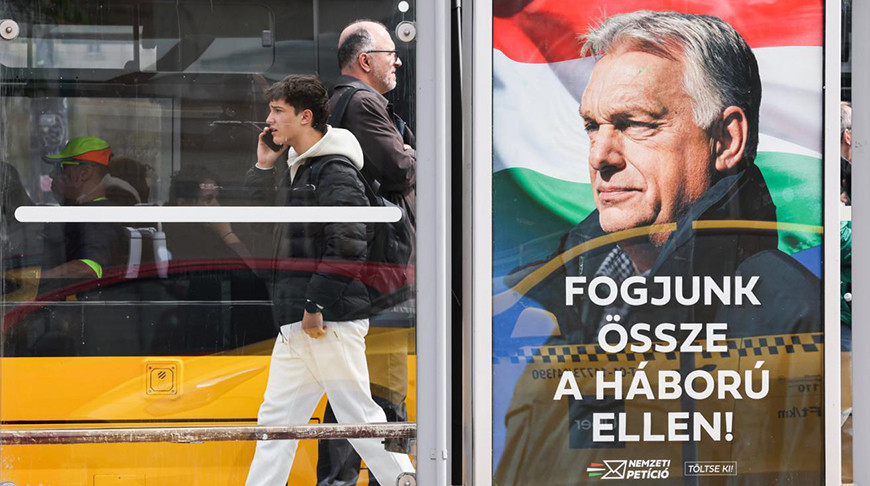
According to the analyst, by the moment of the election, the international experts presented almost equal chances for winning for both candidates. The campaign was not a formalistic ritual for the opponent of the actual prime minister; the rivalry went to the utmost. “It seemed that the leader of Fidesz Party (Viktor Orbán. — note by BELTA) for some extent left the rivalry and decided not to use the whole set of the political and technological instruments for a winning. The election map shows mostly the similarity of the distribution of electorate votes through the regions, excluding some of the districts of the east and west parts of Hungary, which does not affect the whole picture in general,” Dzmitryj Holubnychy highlighted.
The National Electorate Office of Hungary tabulating the intermediate voting results informed that the voter turnout in the country broke the record of the previous years. “The high turnover was, most likely, an accomplishment of Tisza Party (party led by Péter Magyar. — note by BELTA),” the expert said. “The party was succeeded to summon up the most flexible and dynamic electorate — the young voters, residents of large cities, eurooptimists. Magyar in his electoral race positioned his political structure as a party with reformist spirit, ready to reach for reducing the political disruption between Budapest and Brussels, which elicited response in the voters’ minds.”
The results of the elections are also explained by the large-scale pressure of Brussels and a range of the EU governments on Viktor Orbán and his party, which exhausted both the Hungarian establishment and the population. “Such sensitive measures as blocking the pre-arranged resources of budget help were applied. European elite and media depicted Orbán as autocrat whose actions contradict the standards of the west integration and constitutional state. Europarliament and Eurocommission included Hungary in their reports on the risks of corruption, weakening of the justice system independence and reducing the media freedom. Finally, Budapest was openly accused of supposed systematic work for the Russian Federation,” the BISR analyst revealed.
The oppositional Tisza Party achieved victory on the elections in Hungary receiving the 138 seats from 199 in the National Assembly. During the next four years, the party will keep the constitutional majority. Leader of Tisza Péter Magyar is expected to be elected for the office of prime minister on the first parliamentary session, which will be held in the beginning of May. Magyar will replace the current Prime Minister Viktor Orbán, who leads the far-right conservative party “Fidesz — Hungary Civic Alliance.”