
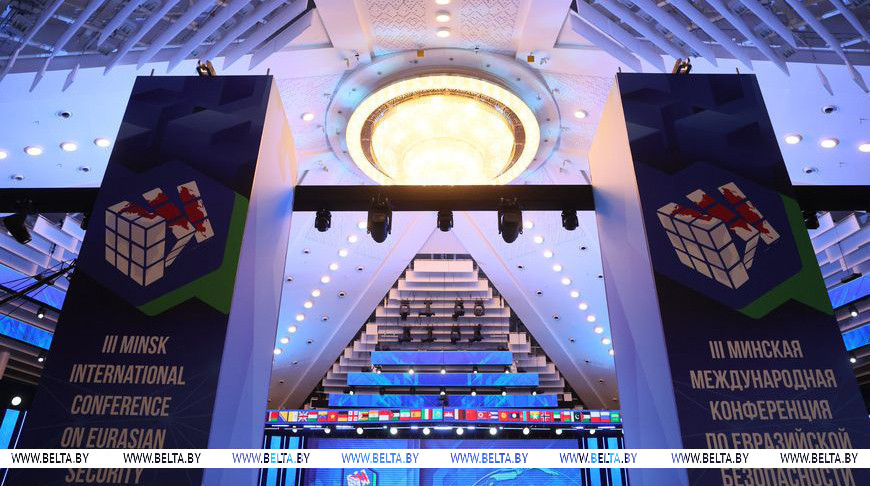
30 October, Minsk /BelTA/ – Minsk has emerged not only as a venue for peaceful negotiations but also as a platform for discussions on the formation of multipolarity and diversity in the twenty-first century. This perspective was shared with BelTA by Siarhei Viarheichyk, analyst of the Belarusian Institute for Strategic Research (BISR), who participated in the 3rd Minsk Conference on Eurasian Security.
Siarhei Viarheichyk specifically touched upon the importance of the Shanghai Cooperation Organisation (SCO) in addressing security issues.
"Security is not the sole item on the SCO’s agenda, yet it defines the Organisation’s priorities and unites the interests of its full members and partner states," Viarheichyk noted. "By virtue of its geographical location, as well as its openness since gaining statehood, the Republic of Belarus experiences the impact of most ongoing geopolitical processes worldwide."
He drew attention to the fact that during the SCO’s establishment and early development, Belarus, lacking common borders with China and Central Asian states, was not directly involved in shaping the security environment of the region.
"Minsk’s primary focus in the external security dimension was on enhancing the role of the Collective Security Treaty Organisation (CSTO) in responding to contemporary challenges and threats. Considering that two key regional organisations share overlapping participants (Russia and the Central Asian states), it can be argued that Belarus, as an active CSTO member, was effectively involved in the multilateral process of shaping the security environment across the space from Brest to Shanghai," the analyst emphasised.
According to him, this engagement was facilitated by close and amicable bilateral relations with all countries participating in the SCO and CSTO.
"When Belarus joined the SCO, initially as a Dialogue Partner and subsequently as an Observer, the shift in the Organisation’s interests towards expanding opportunities for economic cooperation and humanitarian exchanges was taken into account," he continued. "Belarus also demonstrated an interest in fostering cooperation between various integration structures, including the EAEU and the SCO. As President Alexander Lukashenko underlined during his meeting with Chinese President Xi Jinping in Tashkent in June 2016, we are ready to serve as the ‘western gateway’ of the SCO, as the only European state granted Observer status."
Siarhei Viarheichyk noted that in contemporary circumstances Belarus occupies the ‘western frontier’ of the SCO, contributing significantly to regional stability.
"Minsk has become not only a venue for peaceful negotiations but also a forum for discussions on shaping a multipolar and diverse international environment in the twenty-first century, founded on key principles such as non-aggression, the non-use of force or threat of force, and the peaceful resolution of disputes."
Among the terms most frequently used by speakers at the III Minsk International Conference on Eurasian Security were ‘just world order’, ‘equal dialogue’, ‘comprehensive and indivisible security’, and ‘non-targeting of others’. Similar values—mutual respect and trust, equality, dialogue, and the pursuit of common development—form the foundation of the ‘Shanghai Spirit’, noted Viarheichyk.
"The Shanghai Cooperation Organisation, as one of the most representative and influential organisations, has effectively become an integral component of the new international order. As the SCO Secretary-General has emphasised, an equal and indivisible security architecture in Eurasia and a just world order complement the SCO’s efforts to strengthen peace and stability in the region. By becoming part of the ‘Shanghai family’—a strategic choice for Belarus—the country contributes to the cause of ‘comprehensive security based on the principles of indivisibility and cultural-civilisational diversity in paths of sustainable development," the BISR analyst concluded.